
Public Safety Takes Center Stage as Komatireddy Challenges James’ Eight-Year Leadership
By Uttom Kumer Shaha | Progga News Desk:
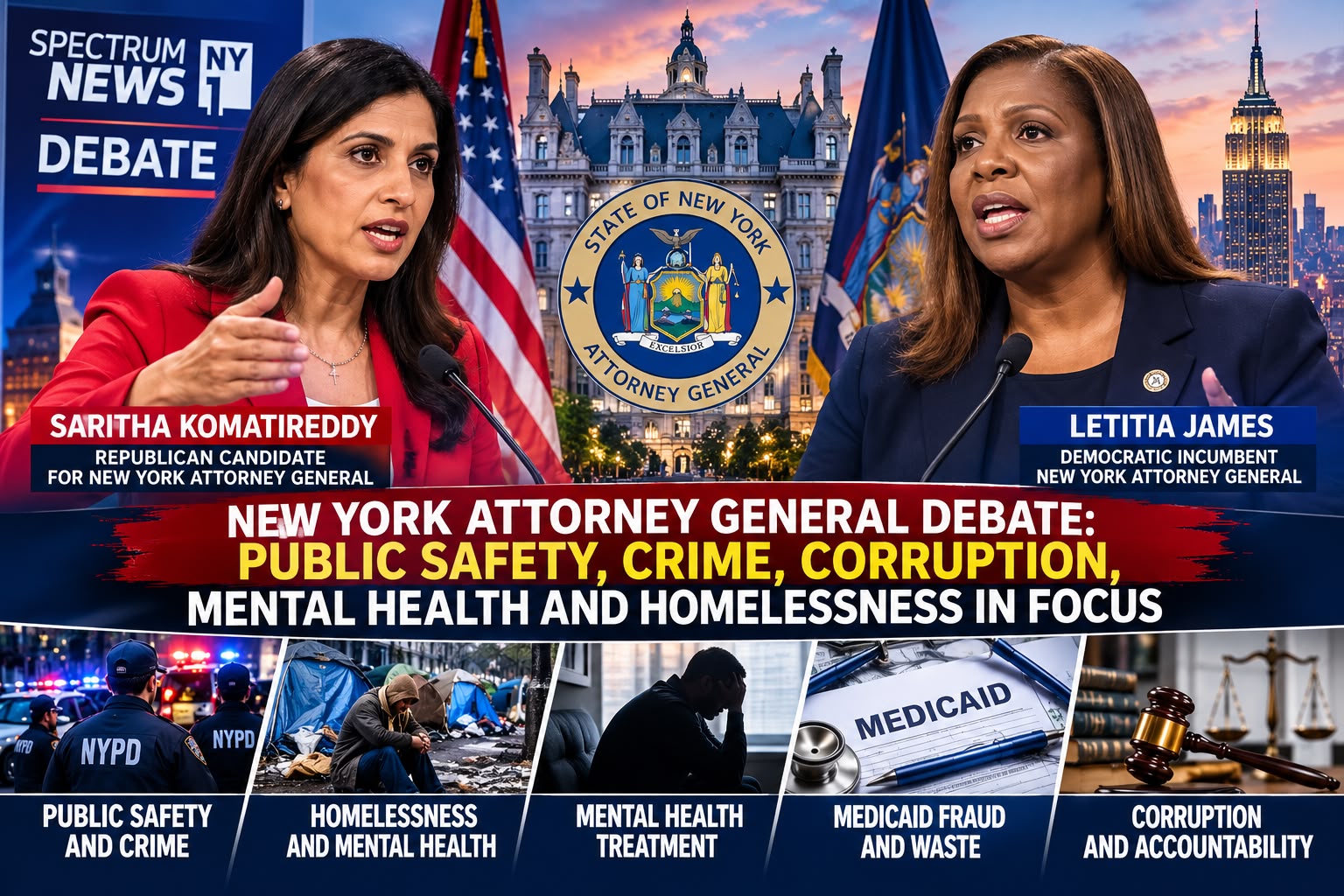
NEW YORK — Public safety, crime prevention, government corruption, misuse of taxpayer funds, homelessness, and mental health services took center stage as New York Attorney General Letitia James, the Democratic incumbent, faced Republican challenger Saritha Komatireddy in a 60-minute televised debate on October 8 at Spectrum News NY1’s studios.
The debate highlighted sharp differences between the two candidates over the responsibilities of the attorney general’s office, the effectiveness of current leadership, and how New York should address growing public concerns about public safety and accountability.
Komatireddy, a former federal prosecutor, argued that under James’ eight years of leadership, the attorney general’s office had focused too heavily on national political issues rather than prioritizing the safety and everyday concerns of New Yorkers. She called for a renewed emphasis on fighting crime, holding repeat offenders accountable, investigating fraud and corruption, and protecting taxpayer dollars.
Drawing on her prosecutorial background, Komatireddy said the office should make more effective use of its existing legal authority to address crime and misconduct. She also emphasized the need for stronger responses to concerns involving homelessness, serious mental illness, and fraud, arguing that New Yorkers deserve leadership focused on practical solutions to problems affecting their communities.
James pushed back, questioning Komatireddy’s understanding of the attorney general’s responsibilities and the scope of the office’s legal authority. She emphasized that the attorney general serves as the state’s chief legal officer, with responsibilities that include civil litigation, consumer protection, safeguarding civil rights, and pursuing legal action in the public interest. Criminal enforcement, she noted, must also operate within the specific jurisdiction and procedures established by law.
Mental Health and Homelessness Policies Draw Sharp Differences
The candidates also clashed over how to address homelessness and mental health challenges, particularly when serious mental illness intersects with public safety.
Komatireddy proposed establishing a separate civil commitment office and expanding access to residential psychiatric treatment. Under her proposal, authorities would work to identify individuals who meet the applicable legal criteria for involuntary treatment and ensure they receive appropriate care.
James criticized the proposal, arguing that creating another government office could add unnecessary bureaucracy. She also raised concerns about the potential return to institutional approaches that could undermine the rights and dignity of people living with mental illness.
The exchange underscored a central policy question facing New York: how to protect public safety while ensuring access to treatment and respecting individual liberty and civil rights.
Crime Prevention and Repeat Offenders
Crime prevention emerged as one of the debate’s defining issues. Komatireddy advocated stronger action against repeat offenders and individuals involved in violent crime. She also called for closer coordination with local law enforcement agencies and more effective use of the attorney general’s existing powers to pursue cases involving criminal conduct, fraud, and corruption.
However, evaluating claims about crime requires careful attention to official data. Crime trends can vary by offense, time period, and geographic area. Assessing whether public safety has improved or deteriorated across New York requires examining reliable government statistics rather than relying solely on political claims.
For residents and business owners, the stakes are significant. Retail theft, fraud, violent incidents, and other criminal activity can affect neighborhood safety, business operations, and public confidence in law enforcement. Effective investigations, support for victims, and consistent enforcement of the law remain important components of a comprehensive public safety strategy.
Protecting Taxpayer Dollars and Combating Medicaid Fraud
Komatireddy also outlined plans to strengthen investigations into government waste, financial misconduct, and Medicaid fraud.
She argued that the attorney general’s office should take a more aggressive approach to protecting public funds, investigating allegations of fraud involving government-funded health care programs, and ensuring accountability when wrongdoing is established.
Her position emphasized the importance of evidence-based investigations, appropriate legal action against those responsible, and stronger safeguards for taxpayer resources.
The broader challenge for the next attorney general will be to ensure that public programs operate effectively, fraudulent activity is addressed, and government resources are used for their intended purposes.
National Politics Enter the Debate
National political divisions also featured prominently in the exchange. Komatireddy, who has received support from President Donald Trump, faced questions from James about her political alignment.
Komatireddy responded that she would defend the interests of New Yorkers regardless of whether an investigation or legal action involved Trump or another political figure.
She also accused James of devoting excessive attention to national political disputes. James, meanwhile, defended her record and the role her office has played in pursuing legal action within its authority.
The exchange reflected a broader disagreement over whether the attorney general’s office has struck the right balance between addressing state-level concerns and taking on matters involving national political figures.
What the Debate Means for New York Communities
For New York’s diverse communities, including immigrant families and South Asian residents, the issues raised during the debate have direct implications for everyday life.
Small-business owners need a safe environment in which to operate. Families want protection from fraud and criminal activity. Residents also depend on access to justice, fair enforcement of the law, and public institutions that remain accountable to the people they serve.
At the same time, public safety cannot be measured solely by promises of tougher enforcement. Effective crime prevention requires sound investigations, appropriate use of legal authority, access to mental health treatment, and respect for civil liberties.
The attorney general’s office has an important role in enforcing state laws, protecting consumers, defending civil rights, and pursuing cases within its jurisdiction. The scope of that role, however, has legal limits, and the effectiveness of any proposed policy will depend on its implementation and available resources.
For voters, the key question is not simply which candidate promises a tougher response to crime, but which candidate offers a credible, lawful, and workable plan to address the state’s most pressing challenges.
Election Puts Leadership and Accountability in Focus
As the election approaches, the debate has brought renewed attention to the candidates’ competing visions for New York’s top law enforcement and civil legal office.
Komatireddy is making the case for a change in leadership, arguing that public safety, fraud prevention, and government accountability should receive greater priority. James is defending her experience and record while challenging her opponent’s understanding of the office and the potential consequences of her proposals.
New York’s early voting is scheduled to begin October 24, 2026, with Election Day set for November 3.
The debate has given voters an opportunity to examine competing approaches to crime prevention, mental health policy, corruption investigations, taxpayer protection, and the attorney general’s responsibilities. Ultimately, the decision will rest on voters’ assessments of each candidate’s record, policy proposals, legal understanding, and ability to deliver results in the public interest.